
Installations
Light shaped for a place.
Lumina Anima develops site-responsive works for architecture, hospitality, retreats, galleries, gardens, private interiors and public environments. Each project begins with the conditions of a particular place: its orientation, sunlight, airflow, circulation, material language and the way people inhabit it.
The aim is not to place a larger object inside a building. It is to create a relationship between light, structure, movement, sound and human presence that belongs to that site.
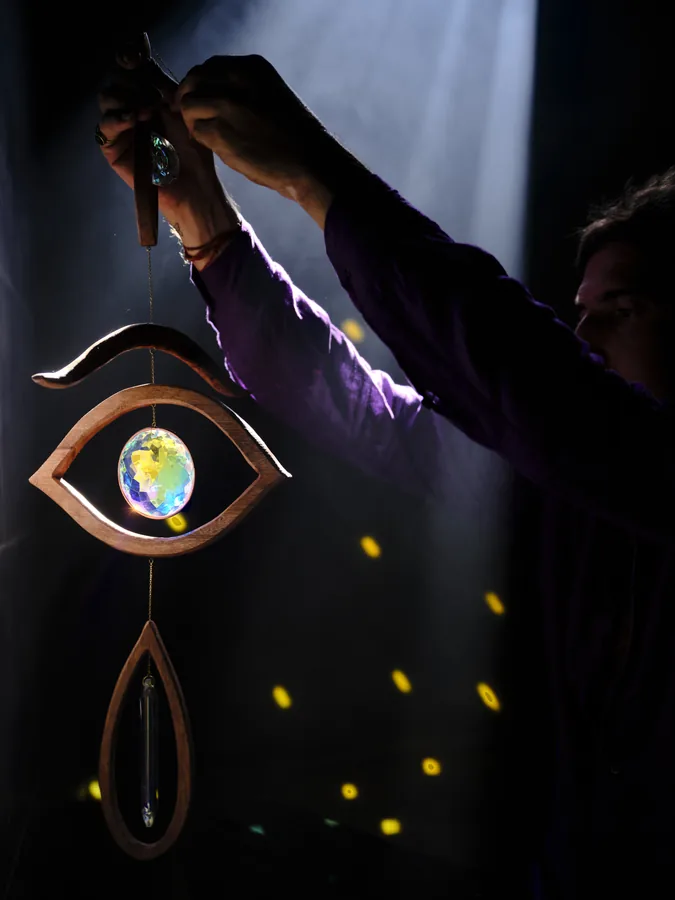
What an installation can become
A field of prisms that sends moving spectra through an atrium. A suspended composition that changes with air moving through a courtyard. A work that joins reflected light with resonant metal and live sound. A series of interventions that reveals the path of the sun through a building.
The form changes with the commission, but the principle remains: the environment is not a backdrop. It is an active material of the work.
Contexts
- Hotels, resorts, restaurants and distinctive hospitality spaces
- Atriums, courtyards, gardens and transitional architecture
- Retreats, contemplative spaces and cultural venues
- Private residences and landscape projects
- Festivals, exhibitions and temporary environments
- Civic buildings, schools, hospitals and public space
The process
-
Encounter
The process begins with the place, the people who use it and the experience the project hopes to create.
-
Site reading
Orientation, sunlight, shadow, airflow, circulation, scale, structure and existing materials are studied as part of the composition.
-
Concept
The proposal defines the experience, form, materials, optical behaviour, acoustic possibilities, technical scope and relationship to the architecture.
-
Development
Prototypes and light tests are used to understand how the work behaves before fabrication begins.
-
Making
The final work is produced with the craftspeople, fabricators and technical collaborators required by the project.
-
Installation
The work is placed, tuned and documented in the environment for which it was conceived.